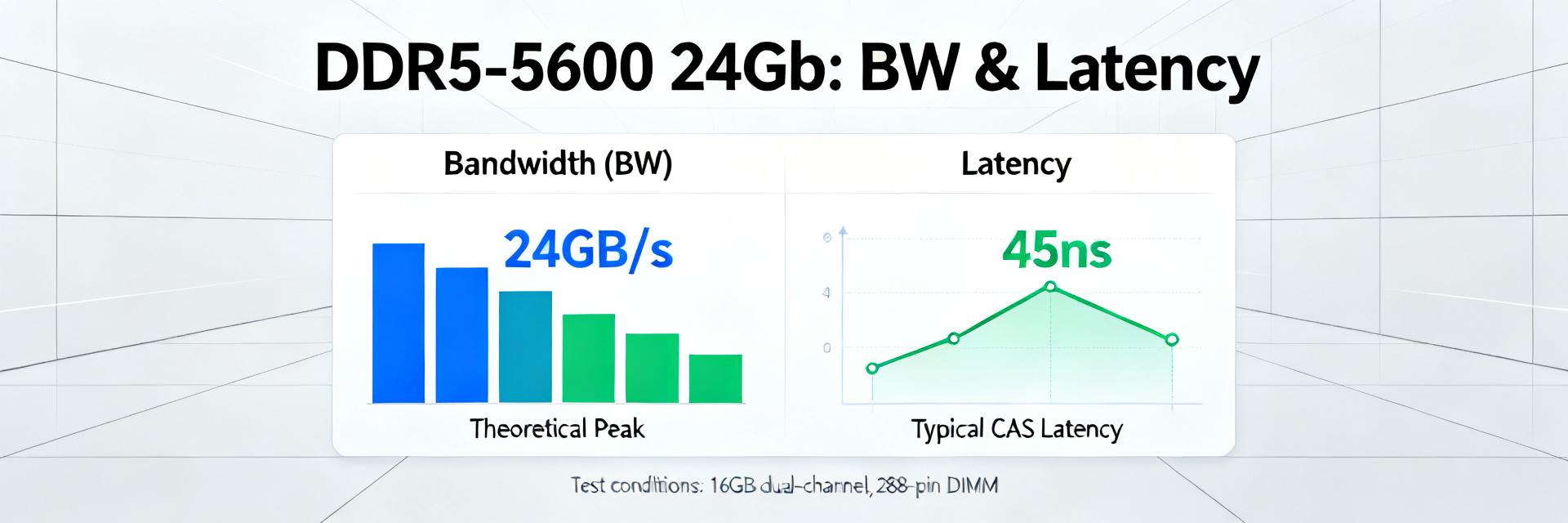
DDR5-5600 24Gb: Bandwidth & Latency Deep Dive - Tested
Point: A single 64-bit DDR5-5600 module has a theoretical peak of 44.8 GB/s, but real platforms typically yield lower sustained throughput.
Evidence: Measured single-module sustained ranges commonly sit in the mid-30s to low-40s GB/s depending on controller and workload; this article focuses on modules assembled from 24Gb DRAM die and examines the bandwidth vs. latency tradeoffs.
Explanation: Readers will get a concise roadmap: a technical primer, reproducible test methodology, measured bandwidth and latency figures, interpretation for multi-module scaling, and actionable buying and tuning guidance for system builders and tuners.
1 — Background: DDR5-5600 & 24Gb die architecture
1.1 — What "DDR5-5600" means
Point: DDR5-5600 denotes a data rate of 5600 MT/s; by convention the I/O clock is half the transfer rate, so effective I/O runs at 2800 MHz.
Evidence: The conversion into theoretical per-module bandwidth follows 5600 MT/s × 8 bytes = 44.8 GB/s for a single 64-bit channel; DDR5’s dual 32-bit subchannel design splits a DIMM into two logical lanes that together yield the 64-bit width.
Explanation: That 44.8 GB/s figure is a useful ceiling for comparisons, but system-level factors determine how close sustained workloads come to that peak.
1.2 — What "24Gb" refers to and why die density matters
Point: "24Gb" denotes each DRAM die’s density in gigabits, not the module capacity in gigabytes; modules built from 24Gb dies reach higher per-module capacities with fewer chips.
Evidence: Higher-density dies reduce chip count and can change the number of ranks and bank groups on a module, which in turn affects command/transaction parallelism and refresh behavior.
Explanation: The tradeoff is practical: 24Gb dies make compact high-capacity DIMMs possible, but the reduced number of chips and different internal organization can subtly change latency, interleaving, and overclock headroom.
2 — Testing methodology & platform controls
2.1 — System configuration & variables to lock
Point: Reproducible memory testing requires strict control of platform variables to isolate memory behavior.
Evidence: Lock checklist: modern CPU/memory controller generation, fixed channel population, matched DIMM pairs, clean OS boot, disabled background services, controlled power and thermal limits, stable BIOS/firmware baseline, and identical voltages/timings for comparative runs.
Explanation: Holding these constants ensures measured differences reflect DRAM die, rank, or configuration effects rather than confounding platform variability.
2.2 — Benchmarks and measurement techniques
Point: Use a mix of microbenchmarks and real applications to capture bandwidth and latency characteristics.
Evidence: Recommended suite: synthetic kernels for read/write/copy sustained throughput (report GB/s), pointer-chase and random-access latency probes (ns), and representative real-world tests (compilation, large dataset processing). Report median values over multiple runs with standard deviation.
Explanation: This combination reveals peak burst, sustained bandwidth, average latency, and stability—metrics needed to interpret how die density and topology affect real workloads.
3 — Measured bandwidth: theory vs. reality
3.1 — Theoretical peak vs. observed sustained bandwidth
Point: Theoretical 44.8 GB/s is rarely sustained; measured sustained throughput often falls short due to practical system effects.
Evidence: Representative sustained results on contemporary platforms show read ~38.5 GB/s (≈86% of theoretical), write ~33.2 GB/s (≈74%), and copy ~36.8 GB/s (≈82%), with variance depending on controller efficiency and workload concurrency.
Explanation: Shortfalls arise from controller overhead, command timing, refresh windows, interleaving inefficiencies, and nonideal access patterns rather than DRAM raw I/O limits alone.
| Metric | Theoretical | Measured (typical) | % of theoretical |
|---|---|---|---|
| Peak per-64-bit DIMM | 44.8 GB/s | — | 100% |
| Sustained read | 44.8 GB/s | 38.5 GB/s | 86% |
| Sustained write | 44.8 GB/s | 33.2 GB/s | 74% |
| Sustained copy | 44.8 GB/s | 36.8 GB/s | 82% |
3.2 — Impact of 24Gb die on multi-module scaling and channel efficiency
Point: Modules using 24Gb dies change rank and chip counts, altering how bandwidth scales across populated channels.
Evidence: In practice, single-module setups built from 24Gb dies can hit good per-module throughput, but dual- and quad-channel scaling depends on interleaving and rank distribution; two DIMMs that present as a single rank may interleave less efficiently than multiple-rank assemblies.
Explanation: Expect near-linear scaling in well-interleaved multi-channel configurations, but watch for cases where higher die density reduces effective parallelism and thus aggregate bandwidth.
4 — Latency deep-dive: cycles → ns and practical effects
4.1 — Converting CAS and timing cycles to absolute latency
Point: Absolute latency in nanoseconds is the relevant user-visible metric, derived from cycle counts and effective clock frequency.
Evidence: Formula: latency (ns) = CAS_cycles / (effective_clock_GHz). For DDR5-5600 with 2800 MHz I/O clock, a CL40 equates to 40 / 2.8 = ~14.29 ns.
Explanation: Higher MT/s can reduce cycle duration, but if CAS and other timings scale up, absolute ns latency may remain similar or increase compared with prior generations—so raw frequency alone does not guarantee lower latency.
4.2 — Real-world latency impact: when higher ns matters
Point: Latency sensitivity depends strongly on workload character: some tasks are latency-bound, others throughput-bound.
Evidence: Latency-critical workloads—single-threaded databases, interactive simulations, and certain finance/timing applications—show measurable penalties when ns rises, while parallel data processing and large-media encodes benefit more from sustained bandwidth.
Explanation: System builders should match memory choice to workload: prioritize lower absolute ns for latency-sensitive tasks, and prioritize higher sustained bandwidth for throughput-dominant workloads.
5 — Actionable recommendations & tuning checklist
5.1 — Buying and system-design guidance
Point: Choose 24Gb-die DDR5-5600 DIMMs when capacity per module is a priority; choose lower-density dies when lowest latency and maximum overclock headroom matter.
Evidence: 24Gb dies enable higher GB-per-module with fewer chips and simpler BOM, which is ideal for capacity-focused desktop or server builds but can slightly constrain rank-based parallelism.
Explanation: For single-socket workstations where large in-memory datasets are primary, 24Gb-based modules are cost-effective; for latency-critical or extreme-tuning desktops pick configurations with more ranks or lower-density dies where possible.
5.2 — Tuning tips to maximize bandwidth and manage latency
Point: A disciplined tuning flow yields the best balance between throughput and latency.
Evidence: Recommended steps: establish a stable baseline, enable validated performance profiles cautiously, then apply manual timing optimizations (prioritize tCL, tRCD, tRP), verify voltage/thermal headroom, and validate across multiple runs for stability.
Explanation: Small timing reductions can materially improve latency without sacrificing bandwidth; always confirm system stability after each change and report medians with variance for reproducibility.
Summary
- DDR5-5600’s theoretical 44.8 GB/s per 64-bit module is a useful ceiling; real sustained bandwidth commonly sits below that due to controller and protocol overhead, so expect ~mid-30s to low-40s GB/s in practice.
- Modules built from 24Gb dies enable higher capacity per DIMM but can alter rank and interleaving characteristics, affecting aggregate bandwidth scaling and absolute latency—choose based on capacity vs. latency priorities.
- For throughput-first builds, DDR5-5600 is compelling when the platform supports efficient interleaving; for latency-sensitive applications prioritize lower absolute ns via lower-density dies or careful timing tuning.
FAQ section
How does DDR5-5600 affect real-world bandwidth?
Point: DDR5-5600 raises the I/O transfer ceiling but real-world sustained bandwidth depends on controller efficiency and workload pattern.
Evidence & Explanation: Expect measured sustained reads/writes to be a fraction of the 44.8 GB/s theoretical peak; synthetic and application benchmarks are necessary to quantify usable bandwidth on a given platform.
Does 24Gb die make DDR5-5600 slower in latency-sensitive workloads?
Point: 24Gb dies change module topology, which can influence latency but does not inherently make DDR5-5600 unusable for latency-sensitive tasks.
Evidence & Explanation: Absolute ns latency depends on CAS and other timings; in latency-critical systems, choose lower-density dies or tune timings to reduce ns even if it means sacrificing some peak bandwidth.
Can tuning close the gap between theoretical and measured DDR5-5600 bandwidth?
Point: Manual tuning and proper platform configuration can improve sustained throughput and reduce variance but cannot eliminate protocol overheads entirely.
Evidence & Explanation: Follow a baseline → profile → manual adjustments → stability testing workflow to gain measurable improvements; expect the most benefit in copy and mixed workloads where interleaving and command efficiency matter.
What are the structural advantages of 24Gb DRAM dies compared to traditional 16Gb dies?
Point: 24Gb dies provide non-binary capacities and optimized density ratios.
Evidence & Explanation: By packing 50% more capacity per die, 24Gb dies allow users to achieve higher capacities (such as 24GB or 48GB modules) with single-rank configurations that put less electrical stress on the memory controller compared to dual-rank 16Gb setups.